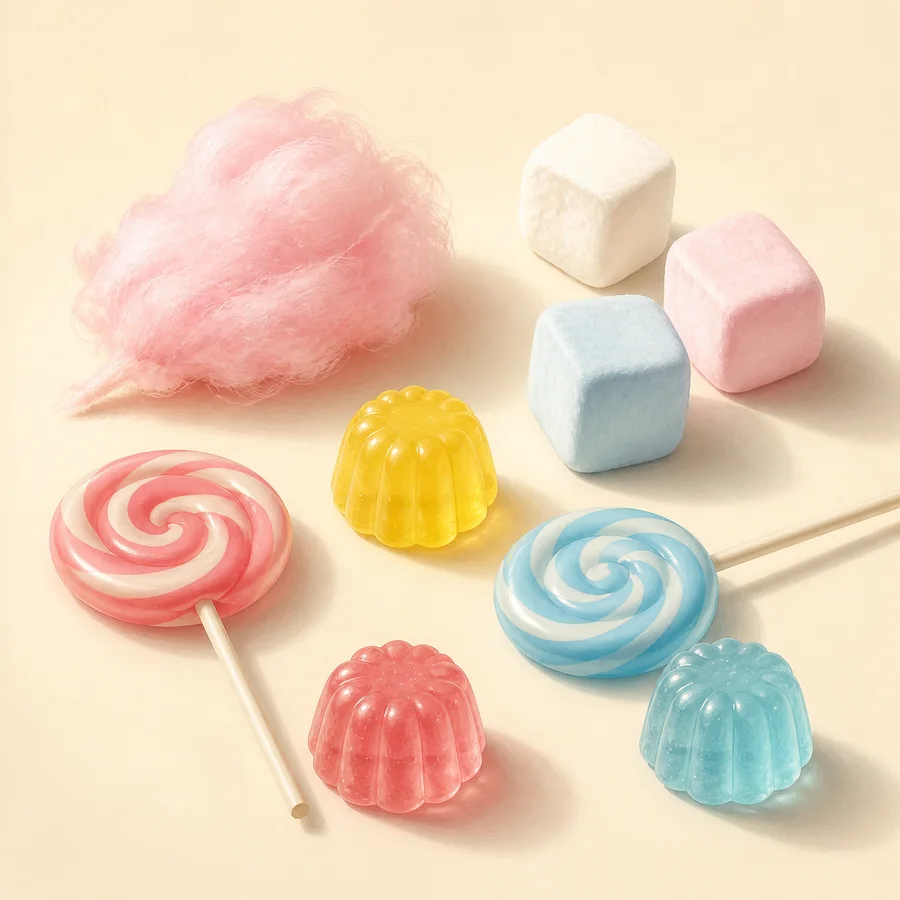
A lollipop combines three simple elements: a round focal form, a straight support and a visible pattern or translucent color. That clarity makes it useful in graphic compositions, but also easy to overrepeat.
Start with the silhouette
At small size, the circle-and-stick outline is immediately legible. Use one or two lollipops to establish vertical direction while lower sweets create a base. If every item stands upright, the table becomes a fence rather than a still life.
Tilt one stick to point back toward the main cluster. Directional lines can guide the eye, but avoid arranging them as pointers toward offers, outcomes or unrelated calls to action.
Control the spiral
A spiral carries internal motion even in a static image. Pair it with calmer solids and translucent jellies so the pattern has room to read. Multiple high-contrast spirals can create distracting optical vibration.
Change scale before changing color. A large pale spiral and a small stronger one feel related without requiring a rainbow of competing hues.
Use material cues honestly
Gloss, translucency and a crisp edge can suggest hard candy visually. Those cues do not identify the recipe, shelf life or manufacturer. In an editorial illustration they belong to the depiction, not a purchasable item.
If photographing real lollipops, retain packaging and label notes off camera. Any public statement about ingredients, allergens or storage should trace back to that product information.
Move from object to graphic motif
For menus, cards or page dividers, simplify the spiral into line and color while keeping text separate and readable. A motif should support hierarchy rather than sit behind every word.
Candy & Color uses small circular accents in the interface but keeps navigation and body text dark. The stronger pastel and candy effects remain inside the illustrations.
Working takeaway
Let one clear lollipop silhouette establish the motif, then balance it with quieter shapes, spacing and accessible typography.
Sources and scope
These references support the general factual framework. They do not endorse this journal or its illustrations.
- U.S. Food and Drug AdministrationFood Allergies
Ingredient and major-allergen labelling context for packaged foods in the United States.
- U.S. Food and Drug AdministrationTypes of Food Ingredients
How ingredient lists and certain color or flavor terms appear on labels.
- American Chemical SocietyCandy Chemistry
Educational overview of glassy, amorphous and partially crystalline confectionery structures.