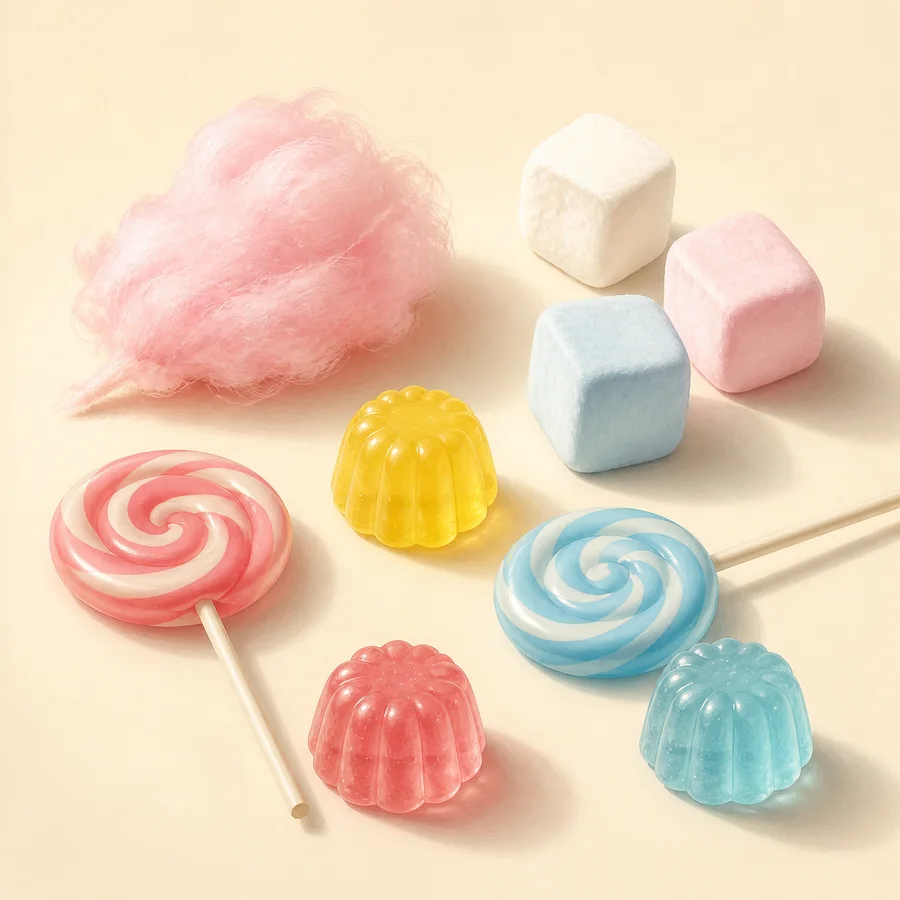
Texture is both something a confection does in the mouth and something a stylist communicates before anyone tastes it. Transparency, edge quality, surface finish and deformation provide visual clues, but the ingredients and handling of a particular sweet still come from its maker’s information.
Hard candy: clarity, facets and brittleness
American Chemical Society teaching material describes hard candy as a sugar glass. In a styling image, that structure often appears through clean facets, sharp highlights and translucency. At room temperature, many hard candies resist deformation and may break rather than bend.
Those are category-level cues, not a promise about every piece. Humidity, temperature, recipe and storage can change the surface and texture. For food safety, ingredients and storage directions must come from the actual label or manufacturer.
Gummies: gel, elasticity and surface treatment
Gummies can be made with different gelling systems, and ACS educational material compares gelatin, pectin and starch in terms of texture and appearance. A stylist should therefore avoid treating “gummy” as one perfectly uniform material. Some pieces are translucent and elastic; others are firmer, cloudier or coated.
Backlighting can reveal color and thickness, while side lighting defines sugar crystals or a matte coating. Keep the light moderate so the most transparent pieces do not lose their edges against a white background.
Marshmallows: soft geometry and cut surfaces
Marshmallow forms communicate softness through rounded edges, small compression marks and a matte or powdery surface. Cubes create a useful counterpoint to circular lollipops and irregular gummies because their simple planes make scale easy to read.
Do not imply a universal formula from appearance. Gelatin, egg, flavorings and allergen considerations vary. The manufacturer’s ingredient and allergen statement—not a styled photograph—controls any product-specific claim.
Cotton candy: volume without weight
Spun sugar produces an airy visual mass with fine strands and diffuse edges. It can occupy a large area without adding another hard contour, which makes it useful for balancing a still life. A small amount can suggest cloud-like volume around denser forms.
It is also highly sensitive to moisture. For a real shoot, follow the maker’s handling guidance and build the composition close to capture time. In our image, the cloud is a digital visual motif, not evidence of a prepared food set.
Working takeaway
Describe visible texture, name the broad structure carefully and defer every ingredient, allergen and storage claim to the current product label.
Sources and scope
These references support the general factual framework. They do not endorse this journal or its illustrations.
- U.S. Food and Drug AdministrationFood Allergies
Ingredient and major-allergen labelling context for packaged foods in the United States.
- U.S. Food and Drug AdministrationTypes of Food Ingredients
How ingredient lists and certain color or flavor terms appear on labels.
- American Chemical SocietyCandy Chemistry
Educational overview of glassy, amorphous and partially crystalline confectionery structures.
- American Chemical SocietyHalloween Candy Chemistry
Educational comparison of common hydrocolloids, appearances and textures in gummies and related sweets.