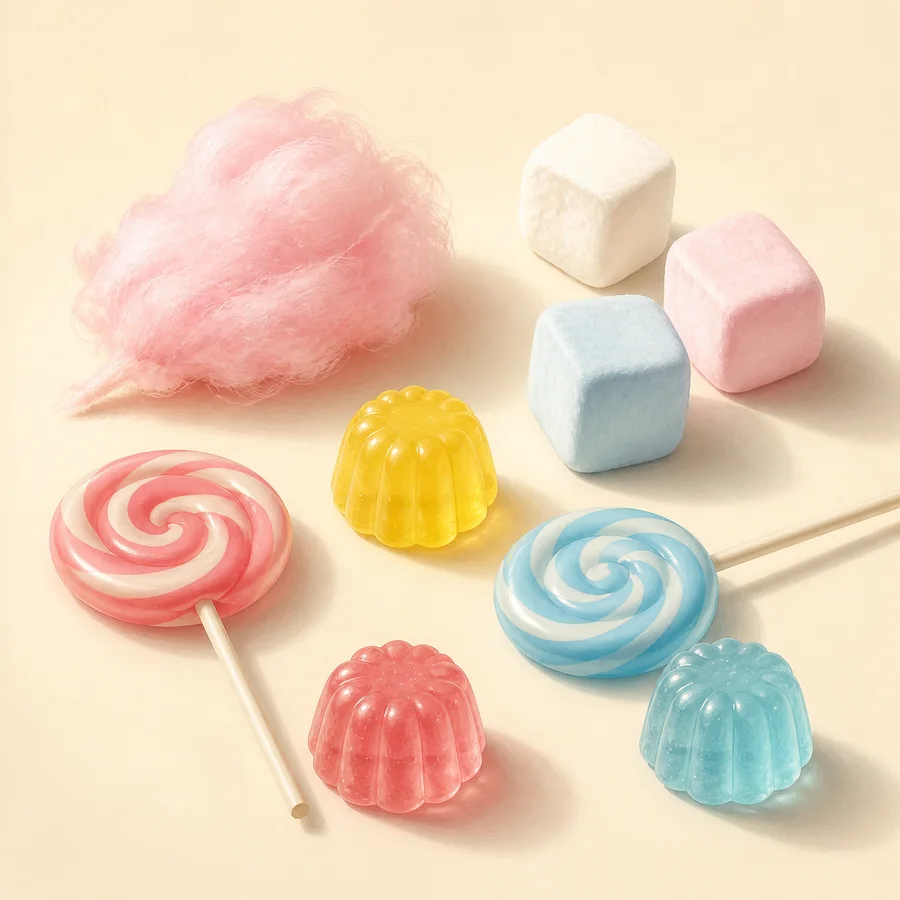
A round tray can suggest unity without becoming a selection device. The distinction comes from composition and function: a still life has no pointer, sectors, random outcome or repeated reward positions. It is simply a bounded surface for arranging forms.
Choose one anchor
Begin with the largest or most distinctive object, such as a tall lollipop or a broad cloud of spun sugar. Place it slightly away from the geometric center so the remaining pieces can create movement around it.
An anchor is not necessarily the brightest object. If it already dominates through scale, keep its color restrained and let a smaller element carry the strongest accent.
Use repetition with variation
Repeat a shape three or four times at different sizes or angles. Circular gummies can echo a round tray; marshmallow cubes can interrupt that rhythm with flat planes. Too many identical pieces placed at equal intervals make the setup look mechanical.
Vary spacing as well as size. Small clusters create local density, while a deliberate gap gives the eye somewhere to rest. That gap should look intentional rather than like an item is missing.
Balance height and footprint
Tall sticks and low jelly forms occupy different kinds of space. View the arrangement from the camera position, because an upright object may hide several smaller pieces behind it. Build from back to front if the chosen viewpoint is low.
For an overhead image, height matters through shadows rather than overlap. Soft side light can reveal the relief of sugar and jelly without creating one hard shadow that divides the tray into sectors.
Keep the tray static
Our Candy Forms illustration uses a plain circular support with ordinary scattered forms. It is not segmented, interactive or presented as a selection mechanism. The caption names it as a conceptual digital still life.
A real styling project should similarly avoid visual devices that promise outcomes unrelated to the food. Labels should identify flavors or allergens only when supported by the maker’s information.
Working takeaway
Use one anchor, varied repetition and visible negative space; a round tray is a surface, not an interactive mechanism.
Sources and scope
These references support the general factual framework. They do not endorse this journal or its illustrations.
- U.S. Food and Drug AdministrationFood Allergies
Ingredient and major-allergen labelling context for packaged foods in the United States.
- U.S. Food and Drug AdministrationTypes of Food Ingredients
How ingredient lists and certain color or flavor terms appear on labels.